
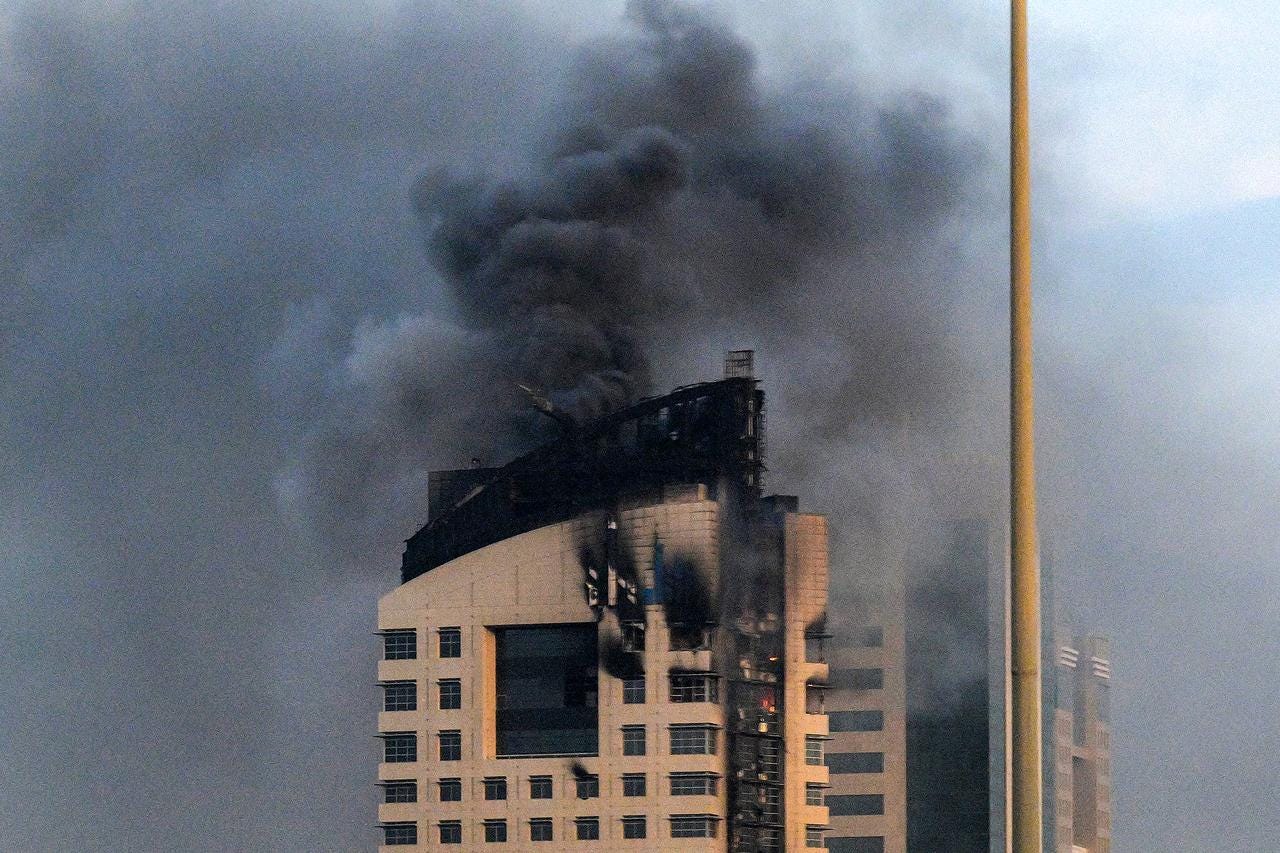
The sirens come every two to three hours.
I am writing this from Kuwait City. When the intercepts fire, you don’t just hear them, you feel them. A thud in the chest. A sound that is somehow both mechanical and ancient. My city has been here before. I have been here before, though I was five years old the last time, and my memories of 1990 are the kind children carry not facts, but feelings. The smell of something wrong. Adults speaking in lowered voices.
Thirty-six years later, the sirens are back.
Kuwait has intercepted 656 missiles and drones since this war began sixteen days ago. We did not start this war. We did not ask for it. We are, by any honest measure, one of the most peaceful nations on earth, a country that gives charity across the world, that has never in its modern history sought to project violence beyond its borders. And yet here we are, absorbing fire in a war that was never ours to fight.
Now we are being asked to formally join it.
The Demand
On March 15, President Trump announced a multinational naval coalition to escort commercial shipping through the Strait of Hormuz. The message that followed was direct: every country that benefits from this strait should contribute to securing it. If you profit from it, you protect it.
The logic sounds clean. It isn’t.
What the demand does not account for is the fundamental asymmetry at the heart of this conflict. America will fight this war from carrier groups and air bases. When it ends and it will end, on terms America decides, on a timeline America controls America will go home. The GCC will not. We will wake up the morning after this war in the same neighborhood we have always occupied, sharing the same geography with the same Iran, living with whatever this war leaves behind.
That is the question nobody is asking. Not what happens during the war. What happens after.
The Neighbor We Cannot Move
Iran has been attacking Kuwait since 1983 seven years before the first American base arrived on our soil. That is a fact. It is institutional memory. The 1983 bombings of the American and French embassies in Kuwait, the assassination attempts on the Amir, the hijackings, the support for internal destabilization all of it predates the American military presence that Iran now cites as its justification for aggression!
After 1990, when Kuwait signed formal defense agreements with the United States and its European partners, Iran understood that direct military confrontation carried a different cost. So the attacks continued but through proxies. What Iran did to Iraq over the following two decades was not an accident of sectarian politics. It was a strategy. Iraq became the most important proxy in Iran’s regional architecture, its government penetrated, its militias armed and directed, its territory transformed into a launching pad.
That strategy is visible in this war in ways that have not been fully reported. The missiles and drones striking Kuwait are not all coming directly from Iranian territory. Many are being launched from Iraq from militias whose organizational and financial links to Tehran are not in serious dispute. Kuwait has documented communications written statements that attempted to frame our territory as a staging ground for attacks against Iran. Those communications were traced back to Iraqi militia networks. The attempt to draw us in through fabrication failed. But the intent was clear.
This is what a wounded Iran looks like when it still has resources and proxies at its disposal.
Imagine what a surviving, humiliated Iran looks like when this war ends.
The War Nobody Will Finish
America does not finish these wars. This is not a criticism it is an observation supported by two decades of evidence. Iraq, Afghanistan, Libya, Syria in each case, American military power degraded the target, reshaped the landscape, and then withdrew, leaving the neighbors to manage the aftermath. The regimes may have changed. The underlying forces did not disappear.
Iran is not Iraq in 2003. It is a state with deep institutional roots, a population of 90 million, and a regional proxy network that has been built over forty years. American airpower and a naval coalition can close Iran’s ability to project conventional military force. They cannot eliminate the ideology, the organizational infrastructure, or the historical grievance that will survive whatever bombs are dropped.
The Iran that emerges from this war will be bloodied. Its conventional arsenal has been largely spent, our intercept data confirms that Iran’s launch rate collapsed by over 90% by day nine of this conflict, its stockpiles degraded faster than any serious analyst predicted. That is not a defeated Iran. That is an Iran that has been humiliated in front of the entire region, stripped of the military deterrence it spent decades building, and left to reconstruct its strategic position from the ground up.
History suggests that states in that position do not become more moderate. They become more dangerous in the shadows.
After America Leaves
Kuwait’s relationship with Iran in the post-war period will be shaped by a simple reality: Iran will remember who stood where.
We did not permit our bases to be used for offensive operations we said so publicly from the beginning of this conflict, and we meant it. Iran attacked us anyway. Whether that was strategic miscalculation, deliberate escalation, or the result of false intelligence we now know was fabricated by militia networks, the missiles landed regardless.
In the post-war accounting, Kuwait will occupy an uncomfortable position. We are not America’s partner in the way that served as justification for the attack. We are not Israel. We gave no offense that a rational state actor could point to as cause. And yet we absorbed 656 projectiles, and we will share a border region separated only by Iraq with whatever Iran becomes next.
Iran has demonstrated, consistently and over decades, that it maintains a long institutional memory of grievance. Its proxy architecture in Iraq means that the border between Kuwait and Iran is not the distance on a map it is the distance to the nearest militia commander who takes orders from Tahran. That distance is measured in minutes, not miles.
Some voices within Kuwait’s own society have been divided on how to process this war. The government’s position has been unambiguous Iran is the aggressor, the attacks are condemned, there is no legitimate justification for what has been done to us. That position is right. But the existence of any internal ambiguity, however marginal and however firmly addressed, is itself evidence of the long-term leverage Iran attempts to maintain in Gulf societies through identity politics and religious framing. It is a tool that survives military defeat. It is a tool that will still exist the morning after.
What We Should Be Doing
Kuwait is not thinking about the post-war. I have spoken to enough people here to know that the dominant posture is survival first, analysis later. That is understandable. It is also, I would argue, exactly the wrong approach.
The structural vulnerabilities this war has exposed did not appear in March 2026. They have existed for decades, acknowledged in policy papers and ignored in budget cycles. Kuwait imports 85% of its food. We have 0.4% arable land. Our sovereign wealth fund the Kuwait Investment Authority, approximately $800 billion has made no serious investment in guaranteed offshore food production, while every other GCC state has moved in that direction. Our food supply runs through a single overland route through Saudi Arabia because Hormuz, the route every supply chain planner warned us about, is now closed.
These are not surprises. They are failures of imagination that this war has turned into emergencies.
The post-war Kuwait that should emerge from this conflict is one that treats the last sixteen days not as an anomaly but as a preview. New defense agreements that reflect the actual threat environment. Agricultural investment abroad that Kuwait has the capital to execute immediately. Infrastructure planning that reduces Hormuz dependency. A military modernization program that builds on what our forces have demonstrated that Kuwait can defend itself and goes further.
And most importantly: a serious, unsparing analysis of what Iran will be when this war ends, and what that means for the neighborhood that remains after America goes home.
The Morning After
The sirens will stop. They always do. Kuwait has survived invasion before, bombardment before, the complete collapse of normal life before. We are, beneath the oil wealth and the sovereign funds, a people who know how to endure.
But endurance is not strategy.
America is fighting this war with the leverage of distance. When it ends, its soldiers will board aircraft and return to bases on other continents. Its policymakers will move to the next crisis. Its analysts will write the post-mortems.
We will still be here. Same coordinates. Same neighborhood. Same Iran across the water and through the Iraqi border, whatever form it takes after the last missile is fired.
The Gulf that emerges from this war has an opportunity perhaps the most significant in a generation to build something more durable than the arrangements that brought us to this moment. A GCC that has absorbed fire together, defended together, and survived together is a GCC with the political foundation to finally act like one.
But that requires someone to ask the questions that are not being asked right now. Not just how do we get through this war. But what do we build when it’s over, and how do we make sure we are never again this exposed, this dependent, and this surprised.
America leaves.
We stay.
The morning after is ours to design.